Tag 408 Stroker build

Show Transcript
I’m about to tear into this 30-year-old Ford 351 Windsor and I’m going to bring you along to see what’s lurking inside. I have to get something out of the way up front: I’ve never torn down an engine before. Not once. So if you’re here looking for decades of engine-building wisdom, this might be the most educational disaster you’ve ever witnessed. That’s what I was afraid of, and that is why exhaust bolts are scary. Holy — I busted my socket wrench. If you’re here to watch a regular guy crack open an old Windsor engine for the first time, you’re in the right garage. Howdy folks, Ed here. Welcome back to Bullnose Garage. I’m not just tearing this engine down and building it back up; I’m learning as I go. I’ve done a lot of research, so I basically know the order to do things in, what to look for, what to keep, what to toss, what matters and what doesn’t. If you’ve never done this before, come along and hopefully you’ll learn something. If you’ve done a couple of engines, come along anyway because you might learn something too — and if not, you’ll get to laugh at me or cry with me. Either way, you’ll be entertained. This engine will be stripped to a bare block, taken to a machine shop, machined for a 408 stroker build, and I’ll show you how that works. Then I’ll source the parts, build it into a 408 stroker, start it on the stand, drop it into my ’85 F-150, and hopefully take it to the track. I’ve been talking about this engine and putting it off for a long time. As an old ex-girlfriend used to say, don’t talk about it — be about it. So let’s get to work. First I’m going to make labels and baggies to make sure I know where everything goes. I probably won’t reuse these, but it’s good to have things labeled just in case. If you’re doing a rebuild and you’re not adding a bunch of new performance parts, definitely label and put away all the parts even if you only have a few. I only have a couple of these rear head bolts, but now I know where they go. Okay, the bolts are off. I’m going to start taking off some of the little brackets and parts that bend to get off. There we go. Motor mounts off. There’s the motor mount—pretty crusty. I’ll almost certainly replace the mount, but I’ll keep the Plate. Now, for my application, which is putting this in a truck that has an inline six, the motor perches do not fit. So I saved the perches from the mounting of this engine from the ’96 F-150 so that I can attach them to my ’85. Hey—dead bugs. Bonus. While I’m over here trying to convince these exhaust bolts to leave the premises, let’s talk about why these things are always such a nightmare. Ford didn’t do anything wrong here; this is just what cast iron manifolds do after 30 years of heat cycles. You have steel bolts threaded into cast iron. The manifold acts like a giant heat sink, and every time this engine warmed up and cooled down, the threads basically just shook hands a little bit tighter. Add in some surface rust, a couple decades of New Mexico dust bacon on there, and these bolts get real sentimental about staying home. The funny part is how they sound when you’re breaking them loose. The first few on this side creaked and groaned like an old door hinge on a haunted house. That’s actually good; it means they’re moving. They’re not happy about it, but they’re still participating in the conversation. What you don’t want is that quiet turn where the head spins without a single complaint. That’s when the bolt stops acting like a bolt and starts feeling just a little bit spongy. That’s the moment you pause and think, “No, this is going to turn into a whole thing, isn’t it?” If you’ve wrenched long enough, you know that silence is the sound of a storm rolling in. All I can really do is hit those things with some penetrating oil, maybe add some heat from a MAP torch. The cast iron soaks that heat away fast, so it only really makes a difference sometimes. Use a lot of slow, steady pressure, patience, and hope for the best. When that fails, you’ll see. Exhaust manifold bolts make me nervous because they’re pretty easy to break. If you break one, you’re pretty much teaching yourself how to weld. I’m going to spray those, let them sit for a little bit, and come back to this side. There we go. And there’s removal of the oil dipstick. It’s just a little bung that presses in. On the passenger side, I stopped short on two of those bolts. I could feel that sponginess starting, and that’s usually my cue to back off and let them soak a little longer. Sometimes walking away is the smartest move you can make. Luckily, I didn’t have the same fight on the driver’s side; those bolts all came out clean with no drama. If you do break a bolt, you’ve got a few options, and what you do depends on the material and how much bolt is still sticking out. If you’ve got a decent amount of thread showing, you can sometimes get away with vice grips or grind a couple flats and put a wrench on it. That works sometimes, but if the head’s already snapped off, chances are the rest of the bolt is still locked in there pretty good. People suggest grinding a slot and trying to back it out with a flathead screwdriver. That can work, but on bolts this stuck, it’s usually wishful thinking. Honestly, the best move is welding a nut onto what’s left. That gives you something solid to wrench on, and the heat from the welding helps break the bond when the threads are seized. A lot of times, the heat cycle helps break the bond. Itself is what actually does the work. If that doesn’t work, you’re down to cutting it flush and drilling it out. That’s not fun or fast, but it is doable with patience, sharp bits, and a steady hand. It’s one of those jobs nobody wants during engine work, but everybody eventually gets. That is why exhaust bolts are scary. I ended up with a crusty old exhaust manifold and a couple of busted-off exhaust bolts. It happens with older engines. Luckily there’s quite a bit of thread left, so there are different ways to get those out. I’ll hit them with penetrating oil, let it soak, and then probably weld a couple of nuts on to get enough bite to back them out. If they break right up against the block, that would be much worse. Since I’m not inside a vehicle, it’s easier. Welding a nut on the end is the way to go. One crusty old thermostat housing. And the water pump is crusty too. I busted my socket wrench — Harbor Freight. I don’t trust it; I might break another one. I tried heat with a butane torch, but it didn’t seem to move the bolts the way it should. At least one bolt snapped off right inside. To get the water pump off I counted seven bolts; one is broken. I tapped progressively with a hammer to loosen it, then gently pried from the back to remove the pump. I’m wrapping up for the night. I busted these two bolts right here for my research. That’s pretty common. These go into the timing cover. This gets corroded and is hard to get out. Once I get my MAP torch ready to go, I’ll warm those up and try to get them out. Same thing over here on the exhaust side. The other side came off clean. This one I snapped two bolts. I’ll get these cleaned up, get a nut welded on, and try to get that back off, but I’m not doing that tonight. To show you what I took off, here are the exhaust manifolds. They’re actually in pretty good shape: big and heavy and a little crusty, but there are no cracks and they do not appear to be warped, so they should be salvageable once cleaned up. They’re not worth a whole lot, but they will be worth something to somebody trying to rebuild a period engine out in Old Windsor. As I said during the first part of the video, these are the engine mounts. I’ll keep the mount parts and just replace the pads. The pads aren’t super expensive; I’ll clean these mounts up and keep them. The thermostat housing and thermostat are basically trash—not really worth saving. Here’s the old crusty water pump. Generally when you do a rebuild you’re going to end up replacing this; water pumps aren’t super expensive. This one’s actually in pretty good shape. You can see back here there’s not a lot of corrosion. There are a couple of rough spots and the water passages are crusty, but nothing major that indicates any real problems with this engine so far. When I took this off I was careful so I didn’t break it, but realistically it’s not worth that much—probably about a hundred dollars brand new. This is a coolant temperature sensor; again, not really worth saving, so that’ll go in the garbage pile. I have a box back here I’m going to start filling with all this stuff. That is the entirety of day one. I spent most of it wrestling those parts off. This evening we’re going to start working on getting the pulley and the harmonic balancer off. If I have time, I may start with the valve covers and the intake, because I can access that stuff without worrying about those bolts, which I’ll deal with once I get my torch. Did that work? Hey, it did. All right. Now, before I could get the crank bolt loose, I had to stop the rotating assembly from rotating. With the engine on a stand, everything wants to spin together, so you need something solid to brace it against. That’s why I bolted the flex plate back on. I don’t need it permanently; I just need a way to lock the crank in place. It took me a minute to find the right tool, but in the end a thick punch through one of the flex plate holes did the trick. Simple, solid, and it let me put real torque on the crank nut without the whole engine turning into a merry-go-round. Heat, heat. There you go. I folded out. While we’re here, quick confession: my first attempt at pulling the harmonic balancer was a no-go. Turns out I… Completely forgot the washer that sits behind the crankbolt. The balancer wasn’t going to go anywhere because it literally couldn’t. It’s an easy mistake to make, especially when you’re in teardown mode and moving pretty quickly, but it’s definitely one of those stop-and-recheck moments. The balancer puller was starting to flex a little as I was cranking on it, so I stopped, stepped back, and re-evaluated. Once that washer was out, things went a whole lot more like they were supposed to. Easy peasy. That sorted the harmonic balancer. I have impact wrenches, but I don’t use them very much. I prefer the ratchet; I like being able to feel it, especially the first time I do a job. Once I get more used to how things should feel, I might start using power tools more, but to start, I really enjoy using my hand ratchets. These valve covers are in really good shape. I’m not going to save them for my build because I want more custom covers, but they might be worth something to somebody. From everything I can see, this looks like an almost perfect 408 rebuild candidate. So far I have not seen anything that gives me pause. You can see varnish inside, which is typical, but it’s nice and uniform. Nothing looks bent or out of true, and there’s no discoloration that would cause alarm. There’s a little crud, but it’s an old high-mileage Ford truck engine, so that’s expected. This is the moment to stop and take a look before pulling anything else apart. To be honest, this is about as boring as it gets, which is great news. Both banks look consistent: same oil film, same coloration, same rocker height. When something’s wrong up top, it almost never hides itself evenly; one cylinder will usually give itself away. You might spot a rocker discolored or blued from heat, which suggests friction or oil starvation, uneven wear on the rocker tip, a pushrod leaning to one side instead of centered on a valve stem, hinting at geometry issues, or even a bent pushrod. Valve springs are another big tell. A broken spring is obvious, but a weak or collapsed spring is sneakier. One spring sitting lower than the rest or a retainer that doesn’t line up with its neighbors is a red flag. The same goes for keepers that don’t look seated evenly; that’s a failure waiting to happen. I’m also watching for oiling clues. Everything here has the normal thin oil coating. If rockers or springs looked dry or heat-stained compared to the rest, I’d suspect oiling problems, but there’s none of that here. In fact, some of these rockers still had little drops of oil from years of sitting in my backyard. Finally, it’s about symmetry. Valve trains should look boringly uniform, just like this. The second cylinder looks different. Different color, different height, different wear. That’s where you stop and wonder what happened to this engine. In this case, nothing stands out: no broken springs, no discoloration, no weird wear patterns. That doesn’t mean the engine is perfect; it just means nothing up top is waving a red flag yet, and that’s exactly what you want before you keep tearing it down. Which is why I sounded so chuffed after I pulled the second cover off. Broken bolts aside, things are going really well for this build so far. Now let’s see if we can get the intake off. Hopefully the intake bolts aren’t completely seized. I started turning one, but I couldn’t tell if it was coming loose. Did I snap it? I didn’t feel it, but I did snap it right off, right onto the head. This is the point where the engine politely suggests a change in strategy. The first intake bolt started to feel spongy and the second one snapped. That was my cue that I was no longer negotiating—I was losing. When bolts start doing that, more force isn’t bravery, it’s false optimism. What you’re actually fighting is corrosion between steel bolts and a cast-iron intake that’s been heat cycling since I was in high school, and cast iron does not respond well to threats. So instead of leaning harder on the wrench, I brought up the torch. The trick isn’t to heat the bolt; it’s to heat the intake around the bolt. You’re trying to make the hole grow, not the problem. Once it’s hot, you let penetrating oil wick into the threads and do what it does best, down where it matters. Does this guarantee success? No. But it turns a coin flip into better odds. After the first bolt went spongy and the second snapped on the intake manifold, I’ll take every advantage I can get. This is what it looks like when you listen to the warning signs instead of arguing with them. After heating the intake and letting the penetrating oil wick in, the bolts actually start coming out the way they’re supposed to: slow, noisy, dramatic—but moving. You can feel the difference immediately. Instead of that spongy, soul-crushing flex, you get resistance, a little creak, and then progress. Clearly heat made a big difference. I did the first one cold and it just snapped like a twig. Look at the gunk coming out of that shaft. At the very least, the rest of the bolts on this side are coming out clean so far. I’m not looking forward to getting that snapped bolt out of the head, but we’ll figure it out. I may have to redo that one. That just popped right off. None of the bolts I heated snapped—not one. Same engine, same tools, same patience, just better physics. It’s not fast, but this is one of those moments where slowing down saves you hours later. Sometimes the win isn’t muscling through; it’s changing tactics before the engine makes that decision for you. Look at all the crap coming out of there. Now that one’s not rough—good stuff. And then there’s this bolt, the one that didn’t get the memo. I went back to it and did everything right: heat it, let it cool, let the penetrating oil wick in, apply gentle pressure, and tap it with a hammer. Heat it again, more oil, more patience, over and over. This was full-on ritual mode, just hoping and praying it would finally decide to cooperate. But here’s the thing: I think the damage was already done. That bolt was my very first attempt before heat ever entered the conversation. Once a bolt starts to twist internally, even just a little bit, you’ve already weakened it. After that, all the heat and patience in the world can’t put the strength back. So eventually physics wins. The bolt doesn’t come out. It gives up and it snaps. That’s the real lesson here. Heat works, technique matters, but timing matters just as much. If you feel that spongy warning early, stop immediately, because once a bolt starts stretching, you’re not removing it anymore — you’re just deciding when it’s going to break. Yep. I’m definitely just going to bust it. Son of a little bastard. Oh yeah, that’s crusty. All right, guys. There’s the underside of the intake. Take a look at this. There is our lifter valley. There’s a little bit of crud in here, but that’ll all get cleaned out. At first glance to my inexperienced eye, it looks pretty good. The only real issue is that I’ve got a bolt down inside the head that’s snapped off, and one that’s sitting a little proud. I need to figure out how to take care of those guys, but the interior looks pretty good. Last night I got the take-off and exposed the lifter valley. It looks pretty good; I’ll give you some B-roll of that here. I tapped off two bolts right here in the front while doing it, so we’ll have to figure out how to get those out later. Right now I’m going to worry about getting these rockers off and the rods out and just checking to make sure that they’re all straight. That will pretty much wrap up the top end of this teardown. By the way, I’ve got several bags made up and labeled with the cylinder numbers on them so I can keep the entire set together: cylinder 1, cylinder 2, cylinder 3, and so on — the rockers, pushrods, and lifters. That way if I want to come back and do some forensics later, I can. It’s not super important to me because I’m going to be rebuilding this into a 408 and none of this stuff is going back in this engine, but if you’re doing a refresh or a straight stock rebuild and you want to reuse some of this stuff, you have to make sure you put them back in the right places. I’m doing it just for forensics, to have a history of what this engine was doing before. Your situation may vary, but it’s always a good idea to label some baggies and keep things together. This is the first one. We’ll go through some more, but just to give you a quick look for those who know what they’re looking for: that’s the lifter side, and there’s the rocker side. Here’s the rocker itself — looks pretty good, rolls nice and straight. There we go. Spider’s out. Now we can pull the dog bone. Nice. And now we can pull the lifter. Nice. Look at that guy. I’m not an expert, but that looks like it’s in really good shape. And now for the inevitable call to action: if you’re enjoying the video, hit like, subscribe, or better yet, check out patreon.com/bullnosegar. You’ll see some neat behind-the-scenes stuff and even more. That’s definitely why you’re here, right? It looks really good. I don’t see anything too concerning—just a little varnish that rubs off with my thumb. Overall, it’s looking really good. What I’m looking for is any discoloration or shape change, especially on the ends—mushrooming or anything like that—and I’m not seeing any of that. Most of these lifters came out looking great: smooth, mirror-like rollers with no visible damage. That’s exactly what you hope to see. A handful had light surface marks on the rollers, but nothing I could feel with a fingernail. Light surface marks are unusual on a used engine, and by themselves they don’t automatically mean the lifter is bad. What matters is whether the wear is purely visual or something you can actually feel. That distinction is huge. On a roller-cam engine, once the hardened surface of the roller is compromised, that lifter isn’t just worn—it’s a liability. Instead of rolling cleanly on the cam lobe, it can start to slide microscopically, and that’s how you eventually wipe out a cam. That kind of damage isn’t just cosmetic and it won’t improve with reuse. In a budget rebuild, lifters can be reused even with light visible wear, as long as they go back in the exact same locations on the same cam. But the moment you can feel wear with your fingernail, that reuse window slams shut. At that point you’re risking the cam, not just the lifter. And to be clear: if you’re changing cams, you change lifters—always. These reuse guidelines only apply when the cam stays exactly the same and the lifters return to their original locations. Flat-tappet cams are even less forgiving. A mismatched roller lifter might cause problems; a mismatched flat-tappet lifter will cause problems. Any visible or measurable wear is usually a deal breaker. Different designs, different tolerances, but the same inspection mindset applies every time. Number three exhaust—I can just barely catch my nail on it, the number three exhaust lifter. You can see a little line there; I can just barely feel it with my nail. This is pretty much normal wear for a Windsor with high mileage, about 30 years old. Compared to the other lifters, this one looks rough because the others are nearly pristine, but it would still be serviceable in an engine running on the road. I wouldn’t put this back into an engine if I were rebuilding it, though. There’s nothing catastrophic going on here. This is the worst one I’ve seen so far. I have one cylinder left—two lifters—and that’s the worst I’ve seen. To be completely clear, when I say “serviceable,” I mean that if this lifter was already running in that engine, a fingernail scratch doesn’t mean it’s going to wipe out the cam tomorrow. But I would never reuse it in a rebuild. Once you can feel wear like that, it’s crossed the line for reuse. In my case, I’m changing the cam anyway, so all these lifters are shelf sitters or knickknacks. Maybe I’ll give a couple to the kiddos for Christmas. Oh, this one looks mirror-finish. Overall, this engine looks fantastic. I couldn’t ask for a better rebuild candidate, a better four-weight stroker candidate than what I have. So far, there are no indications that this engine was ever abused. No signs it was run dry, at high RPM, overheated, or anything like that. The darkening looks like aged oil that’s coated all the surfaces correctly — basically what you get from a 30-year-old engine patina. It looks exactly like what you would want for something like this. The big problem is these bolts that all snapped off. I got a total of six: two here on the front water pump and the timing cover, two at the top of each head, and two on the passenger-side head where the exhaust manifold was. I could just take all this stuff off and toss it. These are just regular truck heads, not anything special. I might get a couple hundred bucks for them, maybe. The timing cover is pretty cheap, basically disposable. I could just pull it and toss it and not worry about getting these bolts out. But because I’m doing content for YouTube and I want to learn — and I just taught myself how to weld — this is a perfect opportunity to see if I can get these out. If I destroy the heads or the timing cover, oh well. What I care about is the block, so this lets me learn on hardware I ultimately don’t really care about. They’re completely different situations: these two are cut off real close with almost no meat, there’s a lot of material on the exhaust-side bolts, and a ton of meat up here. But up here these are going into an aluminum timing cover, so the metals are dissimilar. Here they were going through an aluminum intake, but now they’re going through a cast-iron head, which is a different situation. I can use that to teach myself how to unstick bolts from different metals using different methods — heat, welding, putting nuts on, penetrating oil, and so on. We’ll explore that in a different video. Once that’s done, we’ll flip her over, pull everything off the bottom end, and take a look at the crank, camshaft, oil pan, bearings, and see what kind of wear patterns we’ve got down there. If you want to see what comes next, make sure you like and subscribe. Thanks again for watching. If you have any questions, comments, concerns, gripes, or inner ramblings, stick them below and we will see you next time. If you want to dig deeper into the builds, the side projects, and the stuff that doesn’t always make it on YouTube, or just want to get to know me a little better, come hang out on patreon.com/bullnosegar. It helps keep the lights on, the beer fridge full, and the builds funded. Appreciate you being part of the garage. Thanks again for watching — we’ll see you next time.

Ever wondered what three decades inside a Ford 351 Windsor actually looks like? I cracked open the top end of a 30-year-old 351W and brought the camera along for my first-ever engine teardown. No hero edits, no expert ego… just a regular guy, a pile of baggies, and a growing list of broken bolts.

It’s Part One of a full Windsor teardown series, and the goal is simple: figure out whether this engine deserves a second life as a 408 stroker for my 1985 F-150. Spoiler: despite the bolt carnage, it’s looking good.

The Plan: Strip the Windsor for a 408 Stroker

This engine is getting torn down to a bare block, sent to the machine shop, and built back up as a 408 stroker. Before any of that, I’m staying organized. Labels and baggies for everything, even though I’m not reusing most of these parts. If you’re doing a stock refresh and plan to reuse parts, labeling is non-negotiable. Even for a performance build, it’s handy for forensics later.

Quick side note on mounts: this Windsor is going into a truck that originally had an inline-six, so the perches don’t match. I saved the perches from the donor ’96 F-150 to help with the swap into my ’85.

Exhaust Manifolds: Why Old Bolts Snap

Exhaust manifold bolts are the stuff of nightmares, and this engine reminded me why. Steel bolts in cast iron, 30 years of heat cycles, a dusting of rust… those threads basically married themselves. The driver’s side cooperated. The passenger side? Not so friendly. I stopped on a couple when they got “spongy,” then later ended up with a couple busted-off bolts anyway. Par for the course.

The sounds tell the story. Creaking and groaning means the bolt is mad but moving. Silence with a mushy feel is when you stop and reconsider life choices. That’s when you switch from force to finesse: heat, patience, and penetrating oil.

When Bolts Snap: Realistic Options

  • Penetrating oil and heat: Warm the area, let capillary action pull oil into the threads, then try again with slow pressure.
  • Vice grips or wrench on flats: Works only if enough bolt is sticking out and it isn’t fused solid.
  • Cut a slot for a flathead: Possible, but often wishful thinking with bolts this stuck.
  • Weld a nut to the stud: Best option if there’s a nub to grab. The heat from welding helps break the bond.
  • Drill it out: The last resort. Slow, straight, and sharp bits are your friends.

I’ve got enough thread left on a couple to try welding nuts on. If they were snapped flush, I’d be in for a longer day. Fortunately, this is on a stand, not in a fender well, so access is on my side.

Water Pump and Timing Cover Drama

The thermostat housing and water pump were crusty, no surprise there. I even managed to bust a socket wrench during the process. A butane torch didn’t persuade the water pump bolts, and at least one bolt snapped off inside. In the end, I counted seven bolts on the pump and one broken. Some careful tapping and gentle prying got the pump off.

For the record: snapping bolts in the timing cover is pretty common. The plan is to come back with a MAP torch, warm them up, and try the welded-nut trick. The timing cover itself isn’t precious, but this is a good chance to practice extraction on dissimilar metals without risking the block.

As for the parts pile: the thermostat housing and sensor are trash. The water pump is in better cosmetic shape than you’d expect, light corrosion, nothing alarming, but it’s a routine replacement on a rebuild anyway. The exhaust manifolds look solid, no cracks and no obvious warp, just heavy and crusty. Worth saving for someone doing a period-correct build.

Locking the Crank and Pulling the Harmonic Balancer

With the engine on a stand, everything wants to spin while you try to loosen the crank bolt. The fix: bolt the flex plate back on and run a stout punch through a flex-plate hole to lock it against the stand. Simple and effective.

Pro tip learned the loud way: don’t forget the washer behind the crank bolt when pulling the harmonic balancer. I did. The puller started flexing, I stopped, rechecked, pulled the washer, and then it came off like it should. Easy once you’re not trying to bend physics around a stuck washer.

Valve Covers Off: Boring Is Good

I prefer ratchets over impacts on a first-time job. Feeling what the fastener is doing tells you a lot and can save parts (and your sanity). Under the valve covers, things looked exactly how you want on a veteran Windsor: boringly consistent. Uniform varnish, nothing discolored, no rocker that looked out of place, no obvious geometry issues, and the oil film looked even across both banks.

If something were wrong, you’d usually see it telegraph up top… blued rockers from heat, a retainer sitting low, keepers not fully seated, a pushrod leaning instead of centered. None of that here. Both banks matched in color and height, which is the best possible “nothing to see here” you can get.

Intake Manifold: When Force Fails, Use Physics

The intake manifold tried to teach me a lesson. The first bolt turned spongy. The next one snapped. That’s the moment you admit you’re not persuading the bolt anymore… you’re stretching it. So I changed tactics: heat the intake around the bolt (not the bolt itself), let penetrating oil wick in, and work each fastener slowly.

That change made all the difference. The heated bolts came out noisy and cranky, but they came out. The one I tried earlier, before heat, was already weakened and eventually snapped. Timing matters as much as technique. If a bolt feels gummy, stop early. Once it starts to twist internally, no amount of patience will put the strength back.

With the intake off, the lifter valley looked honest: a little crud, nothing catastrophic. I’ve got one bolt snapped off in a head and another sitting a little proud, and I’ll tackle those later. For a high-mileage truck engine, this all looks about right.

Lifters, Rockers, and Pushrods: What “Good” Wear Looks Like

I bagged and labeled rockers, pushrods, and lifters by cylinder. I’m not planning to reuse them… I’m changing the cam for the stroker… but keeping the sets together is useful if you want to do any post-mortem or reuse on a refresh.

The dog bones and spider came out cleanly, and the roller lifters mostly looked excellent: smooth, mirror-like rollers with no damage you could feel. A few had light surface marks, the kind you can’t catch with a fingernail. On a roller-cam engine, that kind of purely visual wear can be acceptable for reuse, but only if the cam stays and each lifter goes back to its exact original bore.

One lifter, the number three exhaust, had a faint line I could just barely catch with a fingernail. That’s the line between “serviceable in-place” and “do not reuse in a rebuild.” You might drive with it as-is if it’s already paired to that cam and you’re not changing anything, but for a rebuild, especially with a new cam, it’s a hard no. Once you can feel wear, the hardened surface is compromised and it can start sliding instead of rolling. That leads to wiped lobes and tears.

For clarity:

  • Reusing roller lifters can be fine only if they go back in the same bores on the same cam and you can’t feel wear with a fingernail.
  • If you’re changing cams, you change lifters. Always.
  • Flat-tappet engines are even less forgiving; mismatching is basically a failure plan.

Big picture: the valvetrain looks healthy. This Windsor’s top end doesn’t show signs of abuse, oil starvation, or overheating. Just an even patina of old oil and symmetry everywhere. That’s exactly what you want to see before you commit to machine work.

Current Damage Report and Next Steps

Here’s the tally on the snap-a-thon so far:

  • Two bolts at the water pump/timing cover area
  • Two at the top of the heads (intake bolt casualties)
  • Two exhaust manifold bolts on the passenger side

I could toss the timing cover and even the truck heads and move on. They’re not rare parts. But I want to learn and show the process, so I’m going to try multiple extraction methods: heating, welding nuts, and using penetrating oil on both cast iron and aluminum interfaces to highlight the differences. If I wreck a timing cover, I won’t lose sleep. The block is what matters.

From here, I’ll cover bolt extraction in a separate video, then flip the engine, pull the bottom end, and inspect the crank, camshaft, bearings, and oiling situation. After that, it’s off to the machine shop for 408 stroker prep, parts selection, assembly, a run on the stand, and finally into the ’85 F-150. If everything behaves, we’ll take it to the track.

Series Roadmap

  • Top-end teardown (this one)
  • Bolt Extraction
  • Head removal and review
  • Bottom-end inspection
  • Machine shop prep
  • 408 stroker build
  • Engine startup and install
  • Track day

Quick 351W Context (So You Know What You’re Looking At)

The 351 Windsor is Ford’s 5.8L small-block, with a cast-iron block and typically cast-iron heads in truck applications. Later truck variants, like mid-’90s engines, commonly used hydraulic roller cams and lifters, which changes how wear shows up compared to flat-tappet designs. Heat-cycled cast iron and steel fasteners tend to seize over decades… exactly the behavior you saw with the manifold and intake bolts here. It’s not Ford being Ford, it’s metallurgy doing what metallurgy does.

For anyone wondering about the stroker angle: a 408 Windsor build uses a longer-stroke crank and often aftermarket rods and pistons to bump displacement and torque significantly. The block quality (core shift, cylinder wall thickness after machining, main web integrity) matters more than whether your water pump looked pretty on the way out. That’s why uniform top-end wear is encouraging… it suggests the engine led a normal, oil-fed life.

Wrap-Up

Day one and two on the top end gave me exactly what I hoped for: a couple of teachable broken bolts, a reminder that heat and patience beat bravado, and a Windsor that looks like a great 408 candidate. The valvetrain checks out, the lifters told a fair story, and the lifter valley didn’t hide any monsters.

Check out the video above for the full play-by-play, including the “don’t forget the washer” moment. Got tips, questions, or your own bolt horror stories? Drop them in the comments… I read them. And if you want the behind-the-scenes stuff as this turns into a stroker, you can find it on Patreon.


Bullnose Garage at YouTube

If you want more specific information on Bullnose Ford Trucks, check out my YouTube Channel!

For more information on Bullnose Fords, you can check out the BullnoseFord SubReddit or Gary’s Garagemahal. Both are excellent resources.

As an Amazon Associate, I earn from qualifying purchases. If you see an Amazon link on my site, purchasing the item from Amazon using that link helps out the Channel.
Exhaust Cutout Test
Show Transcript

Ever been sitting at a stoplight in your seemingly mild manner V8 when some joker in a new fangled chrome plated Bluetooth infested tow mirror flexing pavement princess of over compensation pulls up and grins like he knows what’s up? You ever want to smoke that guy? Ever want to make him tinkle just a little before you do? Then you, my friend, need some cutouts.

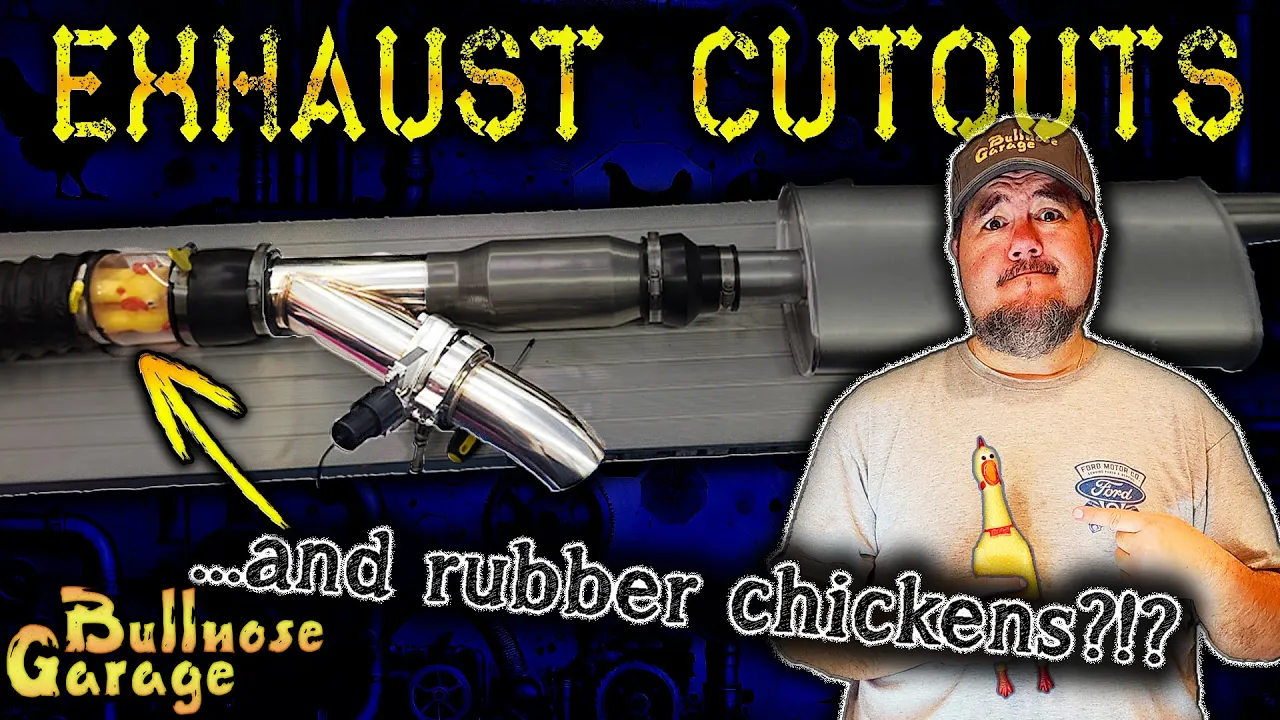
Howdy folks, Ed here. Welcome back to Bullnose Garage, and if you’ve never heard of exhaust cutouts before, stick around because I’m about to use my new chicken chamber here to show you how these nifty devices can let you switch your exhaust note on a dime. And hey, big shout out to Dynox for sending me two 3-inch electric exhaust cutouts to play with before I hook them up to my upcoming 408 stroker build.

Now, before we get these out of my truck, we’re going to do some bench testing. And yes, that means I’m putting my homemade chicken chamber into action. Hello! All right, so let’s start with the basics. What the heck is an exhaust cutout? Well, in simple terms, it’s a controlled bypass valve that lets your exhaust gases take a short shortcut, bypassing your mufflers and catalytic converter when you want maximum volume and minimal restriction. When closed, your truck sounds normal. Hit the switch, instant unfiltered straight pipe chaos.

Now, cutouts are nothing new. Hot rodders have been messing with them for decades. Back in the early muscle car days, guys would literally unbolt sections of their exhaust at the track to let the engine breathe better. Before that, there were even factory exhaust bypass systems on some very old performance cars, but they were usually vacuum or manually operated. These days, thankfully, we’ve got electric cutouts with remotes, meaning you don’t even have to leave the driver’s seat to uncork the beast.

And this right here, this is a 3-inch electric cutout, meaning it runs off 12-volt power and uses a butterfly valve to open and close. It’s got a wireless remote, which is a hell of a lot better than crawling under your truck with a wrench like they used to do back in the day.

So let’s break down the mechanics. Inside this cutout is a butterfly valve, the same basic idea as using your throttle body. It’s a metal plate that rotates on a central shaft. When closed, it seals against the housing—well, mostly. More on that later. And when you hit the switch, a small electric motor turns the shaft, opening the valve and giving your exhaust gases a shortcut to freedom.

Now, here’s the thing: placement matters. If your goal is to commit the audio equivalent of a war crime and turn your neighbors into bitter husks hellbent on evicting you from their lives, then yeah, go ahead and slap that cutout before the catalytic converter. Open it up, and you’re basically running headers. It’s going to be loud, raw, and depending on your local laws, probably a little illegal. But if you actually like your neighbors and at least want to keep peace, then placing the cutout after the cat but before the muffler is usually the way to go. You’ll still get a deep aggressive tone just like you don’t have a muffler on it, but it won’t be quite as ear-splitting as open headers would be.

Now, if you wonder what the actual difference is, it comes down to two very different experiences. Putting the cutout before the catalytic converter means you’ll get the maximum noise with no restriction and zero filtration. If you want your truck to be as loud and free as possible, this is the way to do it. Like I said, it’s loud, raw, and will make your neighbors question their life choices. It may also give you a negligible horsepower boost and less back pressure depending on what cats you’re running.

On the other hand, placing the cutout after the cat gives you what I call controlled aggression. You’ll still bypass the muffler, so you get a deep aggressive rumble, but the cat will take a little bit of the edge off, just enough to make it slightly less of a ‘sir, we need to have a talk’ moment when a cop pulls up behind you. You’re still running cats this way, though, so any restriction that they introduce will still be part of the system when you open these up.

For this demonstration, I’ve got my cutout placed before the cat so we can actually hear the difference when we flip the switch. But trust me, if you put one of these before the cat, you’re basically summoning demons every time you hit the gas. If you’re putting one of these in, though, it’s very probably what you’re going for anyway, so far be it for me to tell you your business.

Now, obviously, my shop vac exhaust stimulator isn’t putting out the same kind of flow as my 408 stroker will, but it still gives us a great way to visualize how the cutout works and, more importantly, how airflow and sound change when we flip the switch.

Now let’s talk real-world pros and cons of running electric cutouts because while they might seem like the perfect solution to all your exhaust tone problems, they do come with their own set of tradeoffs. First off, the pros. I mean, the biggest one is obviously instant volume control. You’re literally flipping a switch to go from quiet and respectable to full-blown hooligan mode in an instant. And there’s also a potential performance gain at high RPM since a free or flowing exhaust can reduce back pressure, though whether that translates into actual measurable horsepower really depends on your system.

And let’s be real, half the fun of having cutouts isn’t about the power; it’s about the sheer joy of knowing you can unleash absolute chaos whenever you feel like it. You’re not stuck choosing between stock sound and straight pipes; you get both. That’s the kind of flexibility that makes these things a lot of fun and so appealing.

But of course, as with most things, it’s not all sunshine and horsepower. The first major downside: they all leak eventually. It’s not a matter of if, but a matter of when. Over time, heat cycles cause expansion and contraction, carbon builds up around the valve, and sooner or later, you’ll start hearing a faint ticking or hissing sound when the valve is supposed to be shut. Now, for some people, that’s not a big deal, and for others, especially if you’re trying to keep things quiet when the cutout is closed, it can be a deal breaker, especially if this is going in your daily driver.

This is really the main issue. These butterfly valves don’t always seal perfectly, and over time, they can start to let little leaks develop. Is that the end of the world? No, but it’s something to be aware of. Routine maintenance goes a long way in keeping them from turning into an annoying rattle factory. Just a quick blast of carb cleaner now and then can help keep the buildup under control. It’s not rocket science; just part of keeping your exhaust system happy and working the way you want it to. If you never clean the valve, carbon buildup could start making it harder to close all the way or even jam it up completely. This is why it’s a good idea to cycle the valve open and closed every now and then, even if you don’t plan on using it every day, like maybe every time you start it up in your driveway or something. I mean, depending on your neighbors, letting it sit in one position for months just lets grime settle in.

And let’s not forget about the motor itself. It’s exposed to dirt, moisture, and road grime, all of which can shorten its lifespan if you’re not careful. A little dielectric grease on the connectors and some basic shielding can go a long way in keeping it working properly. And of course, there’s the big elephant in the room: legality. Depending on where you live, opening that valve on a public road might be technically illegal, especially if you’re bypassing emissions equipment or violating noise ordinances. Some areas are more lenient than others, and let’s be honest, plenty of people run these things without ever having an issue. But if your town has a Karen who dials the cops every time she hears a leaf blower, you might want to keep that in mind before installing one.

Also, as a personal request from me, the old man of Bullnose Garage, respect your communities and don’t open these up in residential areas at night, guys. Be a good steward of your horsepower. This has been a public service announcement from Bullnose Garage.

All right, let’s fire this thing up and see what happens. And away we go! All right, guys, forgive my janky setup here in my messy workbench. I’ve been doing a lot of stuff in here, so anyway, you can see I got things just kind of hooked up through a couple of testing leads to a homemade 12-volt plug that goes to my bench tester, and that runs to the cord. And there’s the control box to the Dynox cutout over here. So in my grubby little paws, I have the remote control, and it’s pretty easy. You just hit the unlock button, and you can see the motor turns this shaft right here, which turns the butterfly valve on the inside. I’ll show you that in a minute, and it’s just like that—super, super simple.

So let me get you down here so you can see the butterfly valve in action. If you can see down inside of there, and I will open it up. There we go, super easy and simple.

All right, guys, now let’s see this action with the chicken chamber. We are going to see if opening this cutout makes those chickens any louder. Now keep in mind that this is a demonstration in my garage with a shop vac and some rubber chickens, so it may not make that much of a difference, but this is the first time I’ve done it, so I’m really curious to see. Okay, here we go. Let’s start our engines. All right, I’m going to open her up. That’s incredible! Listen to that—close, open, close. You can actually hear a difference.

Well, guys, bad news: it overheated and I blew my head gasket. All right, head gasket replaced, good to go. All right, so here’s a little experiment I set up to measure the actual airflow through the system. I’ve got an anemometer here to check how fast the air is moving, kind of like a wind speed gauge, but for our exhaust setup. First, we’re measuring airflow coming out of the muffler with the cutout completely closed. You can see it’s reading right about 12.3 mph, which isn’t too bad considering it’s a shop vac and it’s all being forced through the muffler’s internal baffles.

Now for the second test, I’ve blocked off the muffler entirely, forcing all the air to exit through the cutout. You think this would be the most direct path, right? But check this out: we’re only seeing about 9.5 mph of airflow. And finally, with the muffler unblocked and the cutout wide open, we’re getting around 5.3 mph to the cutout. So what’s going on here? At first, you’d expect the cutout to flow more because it’s basically a straight pipe with a flap, but airflow isn’t just about having an open hole; it’s about how efficiently the air can move through the system.

When we block the muffler, even though all the air had to go through the cutout, the design of the cutout itself, like the butterfly valve, the angle of a T-junction, and the turbulence around the edges created more restriction than I thought. The air doesn’t like making sharp turns, and even with the valve fully open, the flap and the shaft are still in the way, causing turbulence that slows things down. Now, with both the muffler and the cutout open, the airflow has two escape routes, so it splits between them. So while the cutouts give you that aggressive sound and reduced back pressure, under real driving conditions, they’re not a magical free flow hack. Airflow dynamics are a bit more complicated than that. Still, the sound difference? Oh yeah, that’s where the cutout really shines.

Also, keep in mind this is me goofing out of my garage with a shop vac and some rubber chickens. As you can see, the exhaust path is also a completely straight line, and the cutout is right before the cat, which is right before the muffler, and it’s a dryer vent, and there’s all kinds of stuff going on here. So real-world stuff is absolutely going to be different than this, but I still thought this was a really, really neat experiment.

Now, like I said, this setup is obviously not moving as much air as a real V8, but it’s a fun way to demonstrate how exhaust routing changes sound and flow when you bypass your muffler.

All right, guys, let’s take a quick look at just what comes in the box with this 3-inch Dynox cutout. Captain, you got your instruction manual here. It’s pretty simple; it just kind of tells you about the parts and pieces that all come in here. We’ve got our gaskets. Here’s our control module with our remotes, which is super handy. You can also wire these up to be switch operated, which is what I’m going to do when I do mine. I’m not a fan of the remote; I’d rather have a switch on the dash. It’s a little bit more positive for me—just got to flick it, and it comes on. I think that’s kind of neat, but the remotes are pretty cool if you don’t have to worry about wiring up a switch. I don’t mind doing that, so I’m going to do it the hard way. But yeah, that’s pretty cool.

This is the actual butterfly valve, which opens and closes. I will open that up and show you a little bit more about that in just a minute. This is the clamp that goes between the end of the exhaust port here and the rest of the cutout. Obviously, your bolts to clamp everything together and the flange, which is what meets with this part to this part here. And then this connects up to your butterfly valve and the rest of the cutout. And then obviously, this is the meat and potatoes here, which is the actual cutout pipe itself—again, 3 inches of stainless steel glory.

So that is what comes in the box. It’s actually real simple—not a lot of complicated pieces. The remotes make it pretty easy to use, so things never go back in the box the way they came out, which is absolutely typical for all this kind of stuff.

All right, so let’s talk a little bit about this guy here. This is your butterfly valve, and this is what does all the dirty work for these cutouts. It’s what opens up and closes. It’s also the part that’s going to cause you grief down the line when it gets clogged up with carbon or other bits and pieces, or this motor gets crammed up with gunk. Now, if you look at this unit here, you can see this is a rubberized coating on this motor. It’s actually like a little rubber boot that goes on here. Actually, I think I can probably pull it off and show you what’s going on inside of there. Yeah, yeah, pretty simple—just a simple motor there. It’s got that rubber boot on it, which is nice because that’ll help keep the elements out. I think when I install these on mine, I’m going to actually add even a little bit more protection to this than what’s already on here, just to keep it clean and free of gunk and debris.

So yeah, it’s pretty simple. Here you can see the sealing surface on either side, and it just plugs right into the control box. Let me take this off of my other one here. I already got it hooked up with a remote. I will plug that in, and let’s see if my remote works. There we go, pretty simple. Actually, the neat thing with these is that you can have it partially open or partially closed; you just have to make sure that you finish closing or finish opening it. Nothing complicated about that; it’s pretty simple. The trick with these is when you close them, make sure you close them all the way because if you just barely close them, it’s like right there. Okay, so there’s open, there’s closed, and I didn’t really close it all the way. It’s not completely sealed. If you hold it a little bit longer, that little bit around at the end that closes it and seals it up pretty nice. But again, it’s really just a matter of time before this guy ends up not sealing completely just because of carbon buildup and stuff around the edges, right? So you just want to make sure that every now and then you spray some carb cleaner here on this part. Now, it’ll be a little bit tougher once you’ve got the flange on the end here, but you can still get up in there pretty easy. Just crawl up underneath the vehicle and spray some carb cleaner in there a few times just to make sure that it operates smoothly, and that will help. It will give you a little bit more life out of it before it starts to make a bunch of noise. But I really do think, no matter what quality of these things you buy, you’re going to end up getting some leaks eventually. That’s just the nature of the beast. So luckily with these units, they are real easy to disassemble, unbolt, and just swap a new one in if that does happen.

So yeah, there it is. So that’s exhaust cutouts in a nutshell, or in this case, a peanut butter jar full of screaming chickens. You know, big thanks to Dynox for sending me these. I’ll be installing these on my 408 Joker build soon, and we’ll see how they sound in a real-world test. If you’re interested in adding cutouts to your own ride, I will drop a link to these below. You guys, if you like this video, if you like screaming chickens or the thought of making some schmo in his chrome plated pickup tinkle in his undies, hit like, subscribe, and let me know in the comments. Would you ever run cutouts on your setup, or are you the kind of guy who prefers a muffler that actually muffles? As always, if you have any questions, comments, concerns, gripes, internet ramblings, stick them below. And thanks again so much for watching, guys. We will see you next time. She’s rough around the edges, but she’s doing fine, tinkering away, getting things to shine. And oh no, she’s considered divine. Thanks again for watching. We will see you next time. Thanks again for watching. We will see you next time.

Welcome back to Bullnose Garage, where the only thing more questionable than my sense of humor is my choice of testing equipment. Today, we’re bench-testing a pair of DynoVox 3-inch electric exhaust cutouts with a setup that includes a shop vac, a high-flow cat, a muffler, and—wait for it—a peanut butter jar full of rubber chickens. Yeah, you read that right.

What Are Exhaust Cutouts?

If you’ve ever wanted to switch your exhaust note from polite conversation to full-on rock concert with the flip of a switch, exhaust cutouts are your jam. These nifty devices act as controlled bypass valves, allowing exhaust gases to detour around your mufflers and catalytic converter for maximum volume and minimal restriction. Think of it as an instant audio upgrade for your ride.

A Brief History

Exhaust cutouts aren’t exactly new. Back in the muscle car days, folks would literally unbolt sections of their exhaust at the track for better engine breathing. Before that, some factory performance cars had vacuum or manually operated exhaust bypass systems. Thankfully, we’ve evolved to electric cutouts with remotes, so you don’t have to crawl under your vehicle with a wrench anymore.

The Mechanics of Electric Cutouts

Inside the DynoVox cutout, you’ll find a butterfly valve, much like what you’d see in a throttle body. This valve is controlled by a small electric motor, and when you hit the switch, the motor turns the shaft to open or close the valve. It’s a simple concept, but one that comes with its own set of mechanical quirks.

Placement is Key

Where you install your cutouts matters. Slap them before the catalytic converter, and you’re essentially running headers—loud and raw. But if you like your neighbors, consider placing them after the cat but before the muffler for a less aggressive tone. This “controlled aggression” still gives you a deep rumble without waking the dead.

Real-World Testing: Shop Vac Style

To simulate airflow and sound changes, I rigged up my chicken chamber. While a shop vac isn’t quite a 408 stroker, it provides a fun way to visualize how these cutouts work. With the cutout open, the airflow splits between the muffler and cutout, and surprisingly, it’s not always as free-flowing as you’d expect. Turns out, airflow dynamics are a bit more complicated than just opening a flap.

Pros and Cons

Pros:

  • Instant volume control with a switch.
  • Potential for reduced back pressure and slight performance gains at high RPMs.

Cons:

  • Butterfly valves eventually leak due to heat cycles and carbon buildup.
  • Legal considerations—some areas frown upon bypassing emissions equipment.

The Setup and Results

Using my trusty shop vac and anemometer, I measured airflow with the cutout fully closed, fully open, and in various configurations. The results were eye-opening. Even with the cutout open, the design creates some airflow restriction due to turbulence around the butterfly valve. So, while it’s a blast to hit the open road with these, don’t expect them to turn your ride into a race car overnight.

What’s in the Box?

The DynoVox 3-inch cutout kit comes with a control module, remotes, gaskets, and the cutout itself. It’s simple to set up, and you can even wire it for switch operation if remotes aren’t your thing. Just remember that routine maintenance is key to avoiding leaks and ensuring longevity.

Wrap-Up

There you have it—a crash course in exhaust cutouts, complete with rubber chickens. Big thanks to DynoVox for sending these over. I’ll be installing them on my 408 stroker soon, so stay tuned for that real-world test. Meanwhile, let me know if you’re a cutout fanatic or prefer your mufflers to actually muffle. Drop your thoughts in the comments below and, as always, thanks for tuning in.

Check out the video for all the squawking chicken fun and let me know what you think!


Bullnose Garage at YouTube

If you want more specific information on Bullnose Ford Trucks, check out my YouTube Channel!

For more information on Bullnose Fords, you can check out the BullnoseFord SubReddit or Gary’s Garagemahal. Both are excellent resources.

As an Amazon Associate, I earn from qualifying purchases. If you see an Amazon link on my site, purchasing the item from Amazon using that link helps out the Channel.